
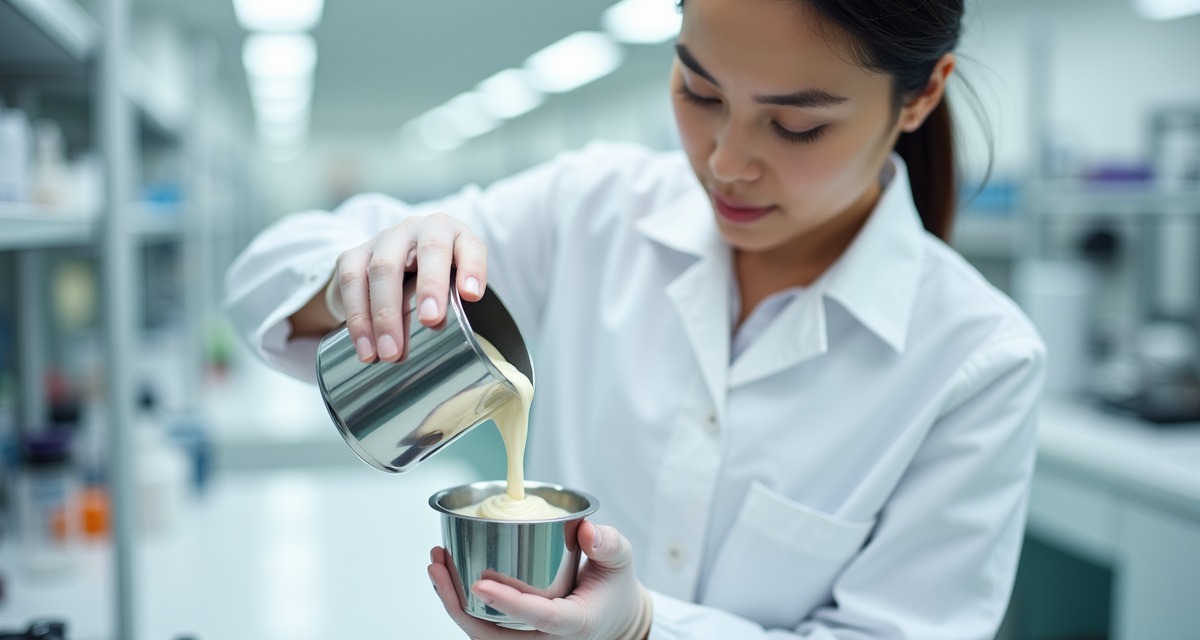
The Custom Cosmetics Formulation Process: What Founders Need to Know
📋 Executive Summary
• Data-Driven Start: The process begins not with ingredients, but with market data, allowing for precise formulation targeting specific consumer needs. • Phased Development: Formulation is a multi-stage process involving R&D, stability testing, regulatory compliance, and pilot runs—it is never linear. • Operational Partnership: Success requires a co-manufacturer who provides transparency, advanced technology, and scalable production capacity.
Reading time: 10 min | Target audience: Intermediate
1. Defining Your Formula: From Concept to Prototype
The journey to a finished product is complex, blending creative vision with rigorous science. Understanding the custom cosmetics formulation process: what founders need to know means recognizing that the initial idea is just the starting point. We guide founders through the technical requirements, ensuring the formula is not only beautiful but also stable, safe, and scalable.
The Initial Briefing and Ingredient Selection
This phase requires extreme precision. You must move beyond aesthetic desires and define measurable outcomes. Our experts analyze your target market, desired efficacy, and budgetary constraints to build a foundational concept.
Key points in bullet format: • Efficacy First: Instead of asking, "What will it look like?", ask, "What problem does it solve?" (e.g., "Reduce redness by 15%," not "Make it red-reducing"). This anchors the formula in measurable science. • Ingredient Deep Dive: We vet every ingredient for function, sourcing reliability, and regulatory standing. Understanding the difference between cosmetic grade and pharmaceutical grade is critical for quality control. • Feasibility Assessment: We assess if your desired ingredients and claims are chemically compatible and manufacturable at scale. This prevents costly dead ends later in the process.
💡 Pro Tip: Always provide competitor products (the good and the bad). Analyzing what works and what fails in the current market gives our R&D team critical data points to build a truly differentiated formula.
Stability Testing and Optimization
Once a prototype is created, the formula must prove its resilience. Stability testing ensures the product will perform consistently on the shelf, regardless of temperature fluctuations or time. This is a non-negotiable step in professional manufacturing.
⚠️ Warning: Never skip accelerated stability testing. A formula that looks perfect in a beaker can degrade rapidly in real-world conditions (heat, light, oxygen). This testing prevents product recalls and reputational damage.
2. Operationalizing Scale: Manufacturing and Quality Control
A perfect formula is only half the battle. The second half—and often the most intimidating—is scaling production. This is where operational excellence and technology prove their value. Our commitment to operational transparency ensures that the transition from lab bench to production line is seamless and compliant.
Formulation Scaling and Pilot Batches
Scaling is not simply multiplying the recipe by 100. It requires re-engineering the process to account for equipment limitations, mixing dynamics, and heat transfer at larger volumes. We execute small, controlled pilot batches to validate the process flow.
Numbered action steps:
- Process Mapping: We document every single step, from raw material intake to filling. This creates a precise, repeatable Standard Operating Procedure (SOP).
- Equipment Validation: We confirm that the specific machinery (mixers, homogenizers, filling lines) can handle the viscosity, temperature, and volume of the formula without compromising integrity.
- Pilot Run Execution: Running the pilot batch under real-world conditions identifies potential bottlenecks, material waste points, and necessary process adjustments before bulk manufacturing begins.
✅ Checklist: Before approving a scale-up plan, verify the following:
- [ ] Final viscosity measurements are within tolerance.
- [ ] Raw material suppliers have validated Certificates of Analysis (COAs).
- [ ] The proposed MOQs align with your projected sales velocity.
Advanced Quality Assurance (QA) and Quality Control (QC)
Quality control is not a department; it is a continuous operational mindset. We employ multi-point QC checks at every stage of the process, from incoming raw materials to the final packaged SKU. Our data-driven approach means every batch is tracked digitally.
| Quality Metric | Testing Method | Industry Benchmark | | :--- | :--- | :--- | | pH Level | Potentiometry | 5.5 – 6.5 (Optimal skin barrier compatibility) | | Viscosity | Brookfield Viscometer | Must match target range ± 5% | | Microbial Load | USP <51> Testing | < 10 CFU/mL (Ensuring safety) | | Appearance | Visual Inspection | Consistent color, clarity, and texture |
Key insight: Relying on a manufacturer with advanced, digital QC tracking (like our operational platform) provides you with an immutable record of quality, which is crucial for brand trust and compliance.
3. Navigating Compliance and Market Readiness
The beauty industry is heavily regulated, and compliance is not optional—it is foundational to building a credible brand. Successful co-manufacturing requires anticipating regulatory hurdles long before the product hits the shelf.
Regulatory Compliance and Safety Documentation
This section focuses on the necessary paperwork and testing that prove your product is safe for human use. We manage the complexity of global regulations (FDA, EU, etc.), allowing you to focus on brand building.
- Safety Data Sheets (SDS): Essential documents detailing the safe handling, storage, and emergency procedures for every component.
- Product Claims Substantiation: Every marketing claim (e.g., "hydrating," "anti-aging") must be backed by scientific evidence or clinical testing, which we help coordinate.
- Ingredient Restrictions: We maintain real-time databases of restricted ingredients (e.g., banned preservatives or colorants) to ensure global market compatibility.
Packaging and Fulfillment Strategy
The final steps involve making the product commercially viable. This includes selecting packaging that is safe, functional, and brand-aligned, and establishing a robust supply chain.
💡 Pro Tip: When selecting primary packaging (jars, bottles), always consider the formula's chemical interaction. Certain ingredients can react with plastics or metals, causing discoloration or destabilization.
Example of Operational Sophistication: Our integrated 3PL (Third-Party Logistics) system means that once manufacturing is complete, your inventory moves directly into optimized warehousing and shipping, maintaining brand integrity from the factory floor to the customer's door.
❓ Frequently Asked Questions
Q: How long does the entire custom formulation process take? A: The timeline varies greatly, but a typical process from initial concept to first bulk run can take 4 to 6 months, depending on the complexity of the formula and the required number of stability tests.
Q: What is the difference between private label and white label? A: While often used interchangeably, private label suggests a more customized, differentiated brand experience built on a core formula, whereas white label typically refers to a more generic, off-the-shelf product line.
Q: Are MOQs (Minimum Order Quantities) always negotiable? A: While we strive for flexibility, MOQs are determined by operational efficiency, equipment setup costs, and quality control requirements. We focus on finding the smallest possible batch size that still ensures consistent quality.
🎯 Key Takeaways
- Data is the Blueprint: Approach formulation with a scientific mindset. Define the outcome you want, not just the look.
- Process > Product: The strength of your brand lies in the reliability of your supply chain. Choose a partner with demonstrable operational excellence and tech sophistication.
- Compliance is Foundational: View regulatory compliance not as a hurdle, but as a core competitive advantage that builds deep consumer trust.
- Scaling Requires Engineering: Scaling up is an engineering challenge, not just a volume problem. Expect multiple validation steps between the lab and the factory floor.
Next Steps
- Immediate action: Compile a detailed "Concept Brief" including target consumer pain points and desired efficacy metrics.
- Short-term action: Schedule a technical consultation with our R&D team to review your ingredient list for compatibility and feasibility.
- Long-term action: Plan your compliance roadmap, anticipating global market expansion and necessary regulatory filings.
Need Expert Help?
Ready to transform your concept into a market-ready, scientifically sound product? Schedule a complimentary consultation with our formulation experts today to review your product vision and map out a precise, data-driven roadmap.
Related Articles: • Private Label vs. White Label: Understanding the Core Differences • Scaling Cosmetics Production: When and How to Increase Volume • Decoding Cosmetic Regulations: What Every Founder Needs to Know